Cool Hunter Predictions: Archie Barry
The artists to watch in the year ahead.
Words: Melissa Ratliff
“I want us all to get hysterical”, critical theorist and filmmaker Elizabeth Povinelli implored attendees at a 2016 event, “we’re breathing each other in”. The entangled, co-dependent conditions of life on earth viscerally glossed in Povinelli’s pre-Covid-19 exhortation could not (at the time) have conjured the same spectre of human togetherness in listeners’ minds as such a statement would have affected today.
As we continue the work of learning to live better on a shared planet, there are many reasons to reflect on the political urgency of re-thinking individualism, including the astonishing work of Sydney born, Melbourne-based artist Archie Barry, known for their riveting performances and videos, and more recent writing, music and sound exploration.
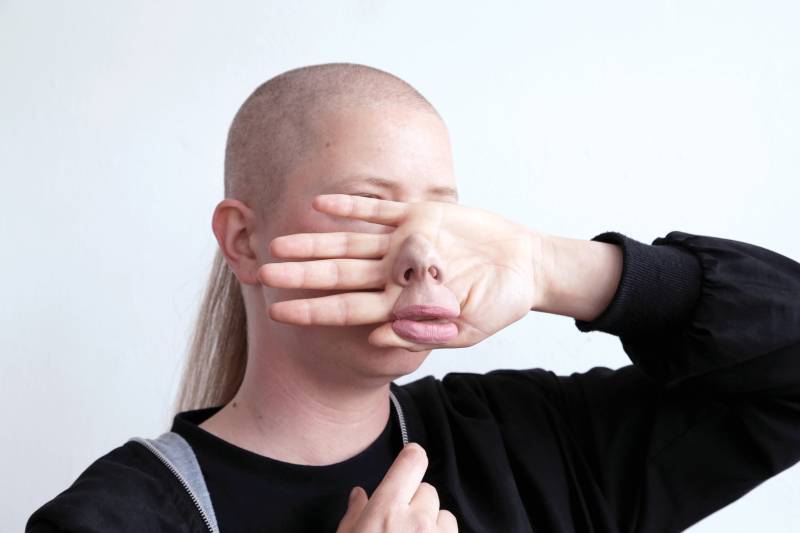
Completing a Masters of Contemporary Art at the Victorian College of the Arts, University of Melbourne in 2017, Barry innovated a form of performance and video self-portraiture that was busy unpacking representability itself. In their graduating year, Barry created the iconic Hypnic, a live duet performed by the artist with a small, sculptural replica of their own nose and lips. Mesmerically corporeal, the work was re-performed on multiple occasions in Melbourne and Sydney over the next two years (at Trocadero Art Space, Australian Centre for Contemporary Art (ACCA), Artspace and Sydney Contemporary).
In this, and prior and subsequent work incorporating prosthetic costumes, Barry was able to explore the notion of bodies as always in transformation and reject the rigidity of boundaried categorisation.
Such a conceptual strategy chimes with art historian, curator and writer David J. Getsy’s call for understandings of personhood “beyond conventional static and binary norms” or broader efforts, as author and theorist Susan Stryker puts it, to “critically trans our world”.
So too does Barry’s music video-like Tatsache, 2017 (which recently entered Melbourne’s Monash University Collection) and its successor Fistimuff, 2019, that use inverted colours, movement and song-style lyrics to destabilise perceptions about reality and subjectivity. For Barry, it is increasingly about “decentralising individualism through affirming multiplicities of selfhood”.
Since 2017, Barry has been regularly called on to present works, performances and talks with major institutions and public galleries: ACCA, Melbourne (2017, 2020); the Centre for Contemporary Photography, Melbourne (2018); Parsons and The New School in New York (2018, 2020); the National Gallery of Victoria, Melbourne (2019, 2020); the Museum of Contemporary Art Australia, Sydney (2019); Minneapolis College of Art and Design, United States (2020); Heide Museum of Modern Art, Victoria (2020–21); and Monash University Museum of Art, Melbourne (2021), where they premiered their Australia Council-supported video commission Scaffolding (Preface). The video marks a recent shift in Barry’s practice towards digitally built personas that heighten the affective and sensorial potential of the body and voice – seen in such works as Multiply, 2020, an ACCA Open digital commission and Blue Dog, 2021, produced for the NGV Triennial program.
Their practice is set to continue evolving. In 2022, local audiences will be treated to a new performance at Melbourne’s Living Museum of the West in February and Sydneysiders can catch the premiere of a new video at Verge in June to July 2022.
Featured image above: Archie Barry, Hypnic, 2017-18. Performance, approximately 4min. Photo: Vanessa Godden. Courtesy: the artist.
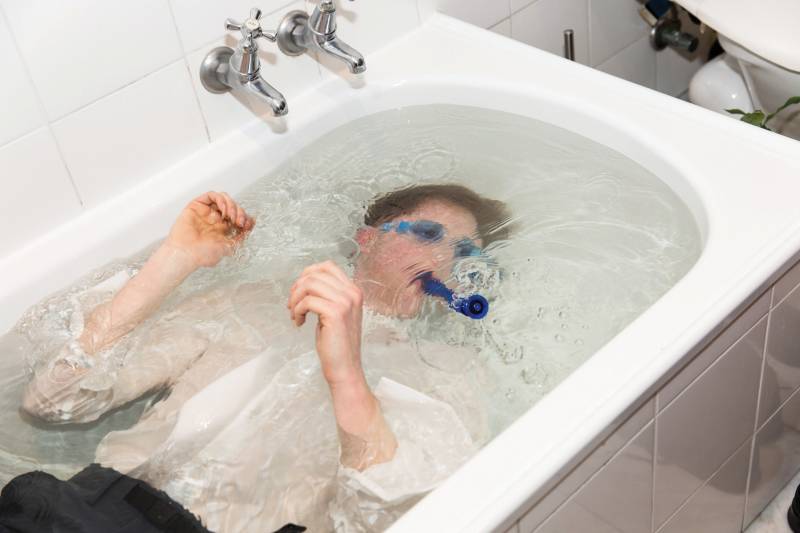
Featured image below: Archie Barry, At home with groin bubble bird, 2019 (performance still). Live performance, approximately 20 mins. Photo: Lucy Foster. Courtesy: the artist.
This article was originally published in Art Collector issue 99, January-March 2022.
FOLLOW THIS ARTIST
READ MORE
 https://artcollector.net.au/wp-content/uploads/2024/04/21A5554.jpg
1200
1200
Erin Irwin
https://artcollector.net.au/wp-content/uploads/2021/11/Art-Collector-logos-transparency-WHITE-1080x1080px-2.png
Erin Irwin2024-04-15 01:59:432024-04-15 02:04:47Artist Profile: Abdullah M. I. Syed
https://artcollector.net.au/wp-content/uploads/2024/04/21A5554.jpg
1200
1200
Erin Irwin
https://artcollector.net.au/wp-content/uploads/2021/11/Art-Collector-logos-transparency-WHITE-1080x1080px-2.png
Erin Irwin2024-04-15 01:59:432024-04-15 02:04:47Artist Profile: Abdullah M. I. Syed https://artcollector.net.au/wp-content/uploads/2024/04/AikoRobinson_AC_AaronClaringbold.jpg
1200
1200
Erin Irwin
https://artcollector.net.au/wp-content/uploads/2021/11/Art-Collector-logos-transparency-WHITE-1080x1080px-2.png
Erin Irwin2024-04-15 01:17:462024-04-15 01:58:32Artist Profile: Aiko Robinson
https://artcollector.net.au/wp-content/uploads/2024/04/AikoRobinson_AC_AaronClaringbold.jpg
1200
1200
Erin Irwin
https://artcollector.net.au/wp-content/uploads/2021/11/Art-Collector-logos-transparency-WHITE-1080x1080px-2.png
Erin Irwin2024-04-15 01:17:462024-04-15 01:58:32Artist Profile: Aiko Robinson https://artcollector.net.au/wp-content/uploads/2024/04/BrieTRENERRY003.jpg
1200
1200
Erin Irwin
https://artcollector.net.au/wp-content/uploads/2021/11/Art-Collector-logos-transparency-WHITE-1080x1080px-2.png
Erin Irwin2024-04-03 08:26:292024-04-03 08:28:54Artist Profile: Brie Trenerry
https://artcollector.net.au/wp-content/uploads/2024/04/BrieTRENERRY003.jpg
1200
1200
Erin Irwin
https://artcollector.net.au/wp-content/uploads/2021/11/Art-Collector-logos-transparency-WHITE-1080x1080px-2.png
Erin Irwin2024-04-03 08:26:292024-04-03 08:28:54Artist Profile: Brie Trenerry https://artcollector.net.au/wp-content/uploads/2024/04/ex.230820_ARTCOLLECTOR__049.jpg
1200
1200
Erin Irwin
https://artcollector.net.au/wp-content/uploads/2021/11/Art-Collector-logos-transparency-WHITE-1080x1080px-2.png
Erin Irwin2024-04-03 07:58:392024-04-03 07:58:39Artist Profile: Monica Rani Rudhar
https://artcollector.net.au/wp-content/uploads/2024/04/ex.230820_ARTCOLLECTOR__049.jpg
1200
1200
Erin Irwin
https://artcollector.net.au/wp-content/uploads/2021/11/Art-Collector-logos-transparency-WHITE-1080x1080px-2.png
Erin Irwin2024-04-03 07:58:392024-04-03 07:58:39Artist Profile: Monica Rani Rudhar https://artcollector.net.au/wp-content/uploads/2024/04/Jan-Murray-Figurine-blue-2023-oil-on-linen-Copy.jpg
2346
2346
Erin Irwin
https://artcollector.net.au/wp-content/uploads/2021/11/Art-Collector-logos-transparency-WHITE-1080x1080px-2.png
Erin Irwin2024-04-03 07:34:162024-04-03 07:34:16Artist Profile: Jan Murray
https://artcollector.net.au/wp-content/uploads/2024/04/Jan-Murray-Figurine-blue-2023-oil-on-linen-Copy.jpg
2346
2346
Erin Irwin
https://artcollector.net.au/wp-content/uploads/2021/11/Art-Collector-logos-transparency-WHITE-1080x1080px-2.png
Erin Irwin2024-04-03 07:34:162024-04-03 07:34:16Artist Profile: Jan Murray https://artcollector.net.au/wp-content/uploads/2024/04/21A4337-copy.jpg
1200
1200
Erin Irwin
https://artcollector.net.au/wp-content/uploads/2021/11/Art-Collector-logos-transparency-WHITE-1080x1080px-2.png
Erin Irwin2024-04-03 07:01:572024-04-03 07:01:57Artist Profile: Kirtika Kain
https://artcollector.net.au/wp-content/uploads/2024/04/21A4337-copy.jpg
1200
1200
Erin Irwin
https://artcollector.net.au/wp-content/uploads/2021/11/Art-Collector-logos-transparency-WHITE-1080x1080px-2.png
Erin Irwin2024-04-03 07:01:572024-04-03 07:01:57Artist Profile: Kirtika Kain