Curator’s Radar: Imogen Taylor
A round up of artists who have recently attracted significant curator attention by way of commissions, acquisitions and inclusion in major public exhibitions.
Words: Lucinda Bennett
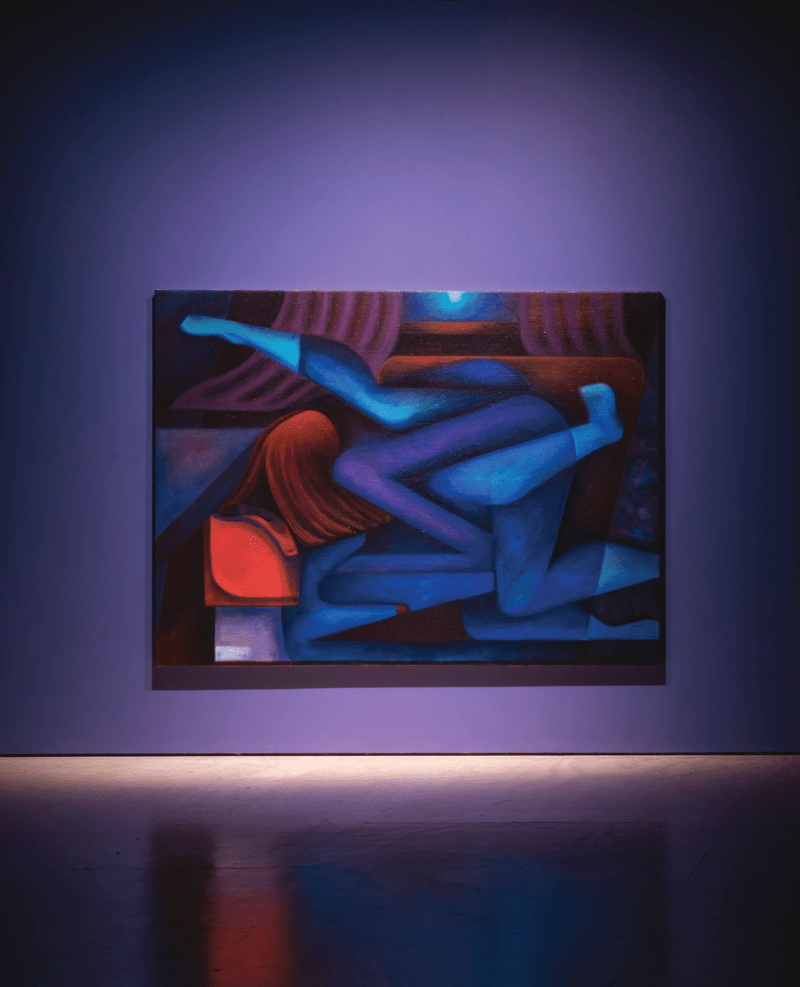
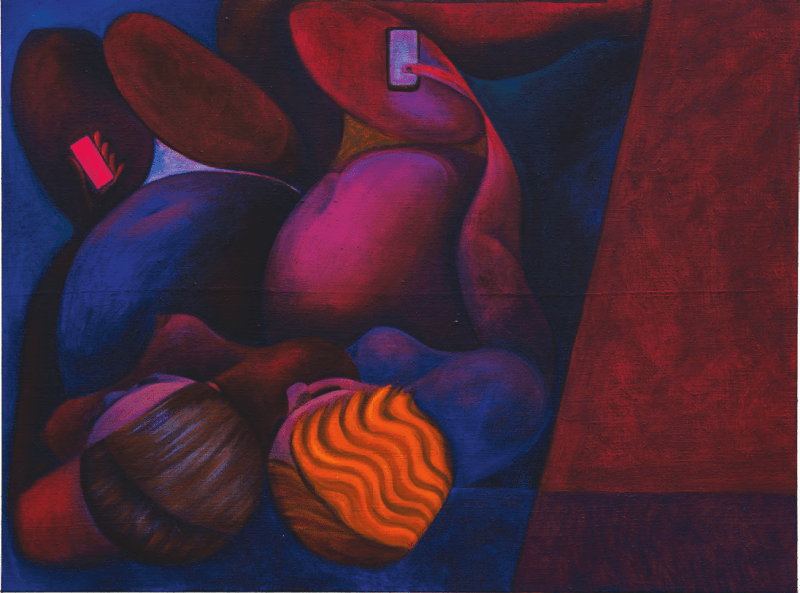
In 2022, Auckland-based Imogen Taylor’s exhibition Quiet Motel opened at Whangārei Art Museum. While the show was something of a homecoming for Whangārei-born Taylor, it was also a departure from the formal abstraction familiar to viewers of Taylor’s work. In Quiet Motel, Taylor embraced figuration: the soft moonlit curves of a sleeping woman, a tangle of limbs, long hair and pendulous breasts, the alien form of a squid laid on a platter, a wedge of citrus nestled in beside. Taylor explains, “I had initially painted more figurative work, but used abstraction as a vehicle to conceal the more explicit or erotic themes I’d always been drawn to depicting. In some ways, the art world felt way too homophobic for me, a young artist at the time, to present paintings that uncovered sordid queer desire. Queer art practices were visible for sure, but not so much by queer women or non-binary artists. A lot has changed in ten years.”
Queer eroticism is at the fore of Quiet Motel, with paintings such as Wet With Dew, 2022 – which depicts a tunnel of fleshy trees, a pearl of a moon hanging above, encircled in red, throbbing – leaving little to the imagination. Ironically, Quiet Motel is one of Taylor’s less explicit exhibition titles, the openly queer sexual content of this show perhaps rendering the subtle queer coding of previous titles – In & Out, Glory Hole and Balls Deep – redundant. In recent years, Taylor has been the recipient of numerous residencies, chief among them being the Frances Hodgkins Fellowship in 2019, which resulted in the luscious exhibition Sapphic Fragments at Hocken Collections Uare Taoka o Hākena, Dunedin in 2020. Two years on and back up north, it seems Frances Hodgkins has continued to cast her influence over Taylor. When asked what drew her to the night – for all the paintings in Quiet Motel are nocturnes – Taylor is frank. “Let’s face it, the lockdowns of the last two years were bleak and at times depressing for many people. I felt motivated to make nocturnes because I’d seen ones by Hodgkins that she’d painted during wartime. And far out they were so desolate.” Despite their bleak origins, Taylor’s nocturnes hum and glow, muffled moans of pleasure and vibrant colour shining through layers of dusk.
Taylor is represented by Michael Lett, Auckland.
Featured image above: Imogen Taylor, Moths, 2022. Acrylic on hessian, 150 x 200cm. Installation view of Quiet Motel, Whangārei Art Museum, 2022. Photo: Tessa Paton.
Featured image below: Imogen Taylor, Limb Report, 2022. Acrylic on hessian, 150 x 200cm. Photo: Samuel Hartnett. Courtesy: the artist and Michael Lett Auckland.
This article was originally published in Art Collector issue 103, January-March 2023.
FOLLOW THIS ARTIST
READ MORE
 https://artcollector.net.au/wp-content/uploads/2024/04/21A5554.jpg
1200
1200
Erin Irwin
https://artcollector.net.au/wp-content/uploads/2021/11/Art-Collector-logos-transparency-WHITE-1080x1080px-2.png
Erin Irwin2024-04-15 01:59:432024-04-15 02:04:47Artist Profile: Abdullah M. I. Syed
https://artcollector.net.au/wp-content/uploads/2024/04/21A5554.jpg
1200
1200
Erin Irwin
https://artcollector.net.au/wp-content/uploads/2021/11/Art-Collector-logos-transparency-WHITE-1080x1080px-2.png
Erin Irwin2024-04-15 01:59:432024-04-15 02:04:47Artist Profile: Abdullah M. I. Syed https://artcollector.net.au/wp-content/uploads/2024/04/AikoRobinson_AC_AaronClaringbold.jpg
1200
1200
Erin Irwin
https://artcollector.net.au/wp-content/uploads/2021/11/Art-Collector-logos-transparency-WHITE-1080x1080px-2.png
Erin Irwin2024-04-15 01:17:462024-04-15 01:58:32Artist Profile: Aiko Robinson
https://artcollector.net.au/wp-content/uploads/2024/04/AikoRobinson_AC_AaronClaringbold.jpg
1200
1200
Erin Irwin
https://artcollector.net.au/wp-content/uploads/2021/11/Art-Collector-logos-transparency-WHITE-1080x1080px-2.png
Erin Irwin2024-04-15 01:17:462024-04-15 01:58:32Artist Profile: Aiko Robinson https://artcollector.net.au/wp-content/uploads/2024/04/BrieTRENERRY003.jpg
1200
1200
Erin Irwin
https://artcollector.net.au/wp-content/uploads/2021/11/Art-Collector-logos-transparency-WHITE-1080x1080px-2.png
Erin Irwin2024-04-03 08:26:292024-04-03 08:28:54Artist Profile: Brie Trenerry
https://artcollector.net.au/wp-content/uploads/2024/04/BrieTRENERRY003.jpg
1200
1200
Erin Irwin
https://artcollector.net.au/wp-content/uploads/2021/11/Art-Collector-logos-transparency-WHITE-1080x1080px-2.png
Erin Irwin2024-04-03 08:26:292024-04-03 08:28:54Artist Profile: Brie Trenerry https://artcollector.net.au/wp-content/uploads/2024/04/ex.230820_ARTCOLLECTOR__049.jpg
1200
1200
Erin Irwin
https://artcollector.net.au/wp-content/uploads/2021/11/Art-Collector-logos-transparency-WHITE-1080x1080px-2.png
Erin Irwin2024-04-03 07:58:392024-04-03 07:58:39Artist Profile: Monica Rani Rudhar
https://artcollector.net.au/wp-content/uploads/2024/04/ex.230820_ARTCOLLECTOR__049.jpg
1200
1200
Erin Irwin
https://artcollector.net.au/wp-content/uploads/2021/11/Art-Collector-logos-transparency-WHITE-1080x1080px-2.png
Erin Irwin2024-04-03 07:58:392024-04-03 07:58:39Artist Profile: Monica Rani Rudhar https://artcollector.net.au/wp-content/uploads/2024/04/Jan-Murray-Figurine-blue-2023-oil-on-linen-Copy.jpg
2346
2346
Erin Irwin
https://artcollector.net.au/wp-content/uploads/2021/11/Art-Collector-logos-transparency-WHITE-1080x1080px-2.png
Erin Irwin2024-04-03 07:34:162024-04-03 07:34:16Artist Profile: Jan Murray
https://artcollector.net.au/wp-content/uploads/2024/04/Jan-Murray-Figurine-blue-2023-oil-on-linen-Copy.jpg
2346
2346
Erin Irwin
https://artcollector.net.au/wp-content/uploads/2021/11/Art-Collector-logos-transparency-WHITE-1080x1080px-2.png
Erin Irwin2024-04-03 07:34:162024-04-03 07:34:16Artist Profile: Jan Murray https://artcollector.net.au/wp-content/uploads/2024/04/21A4337-copy.jpg
1200
1200
Erin Irwin
https://artcollector.net.au/wp-content/uploads/2021/11/Art-Collector-logos-transparency-WHITE-1080x1080px-2.png
Erin Irwin2024-04-03 07:01:572024-04-03 07:01:57Artist Profile: Kirtika Kain
https://artcollector.net.au/wp-content/uploads/2024/04/21A4337-copy.jpg
1200
1200
Erin Irwin
https://artcollector.net.au/wp-content/uploads/2021/11/Art-Collector-logos-transparency-WHITE-1080x1080px-2.png
Erin Irwin2024-04-03 07:01:572024-04-03 07:01:57Artist Profile: Kirtika Kain