New Directions: Kenny Pittock
Artists who have recently taken their practice somewhere different.
Words: Emma Finneran
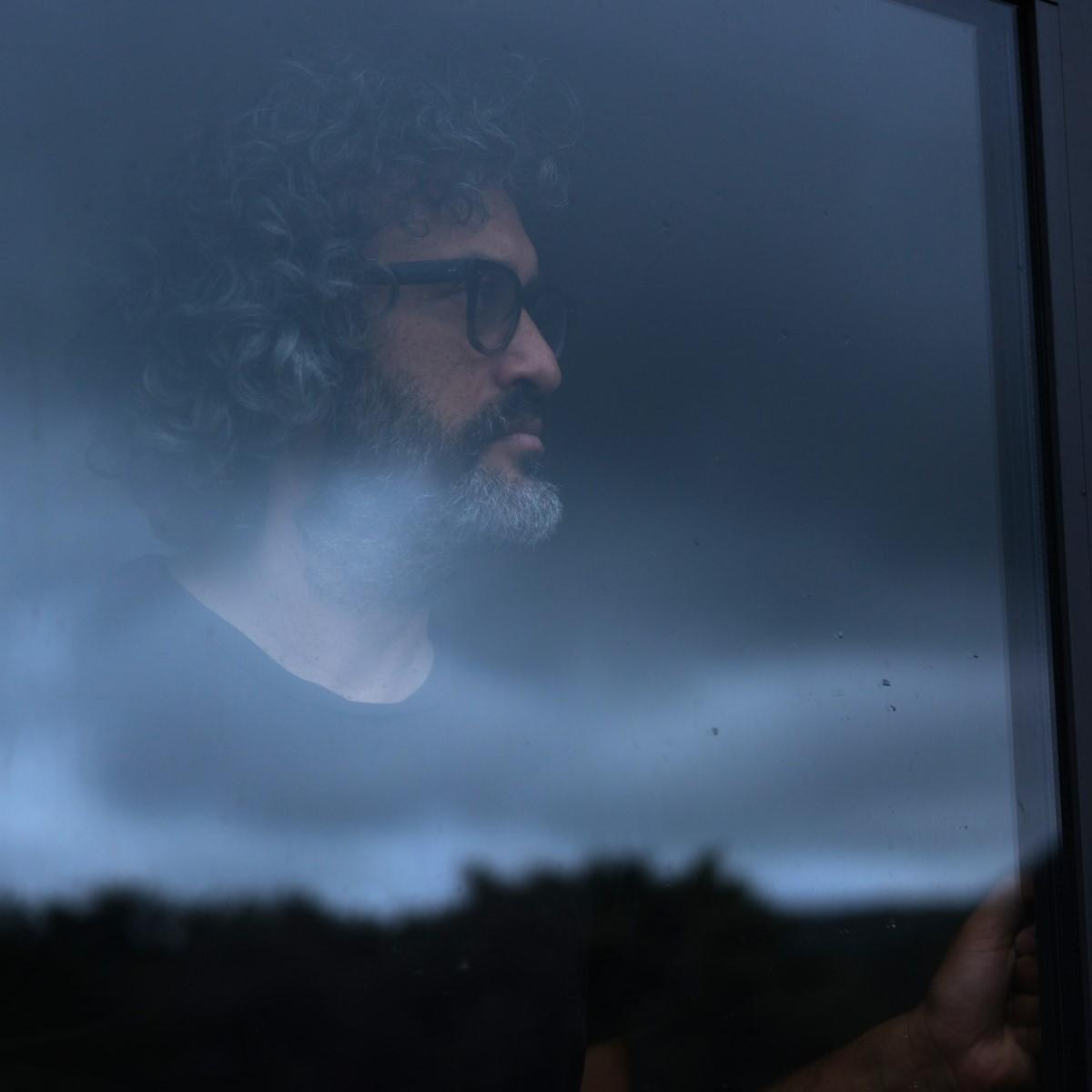
“Big ideas can be nothing but hot air, at times,” wittingly quips artist Kenny Pittock, wellknown for his whimsical, life-sized ceramic renditions, and pithy paintings addressing the banality in life, “however, blowing air as a medium, with all its lightness and fragility, feels so relevant.” Pittock, who is represented by MARS Gallery, Melbourne and has established himself as an expert in evoking nuanced responses to the mundanity in life using nostalgic iconography and colloquialisms, has recently conflated his practice – and rhetoric – and literally inflated it.
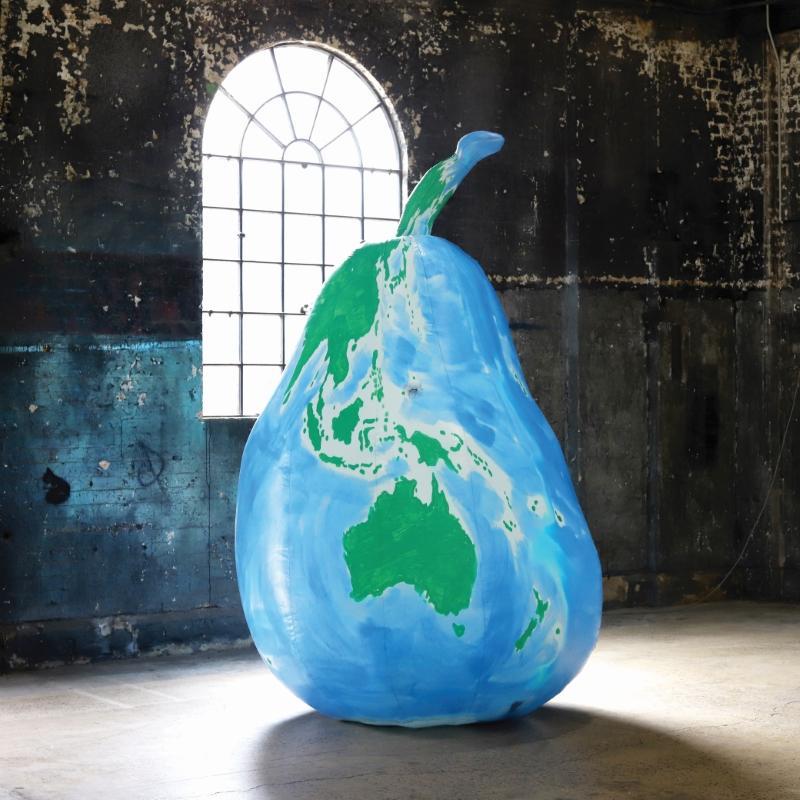
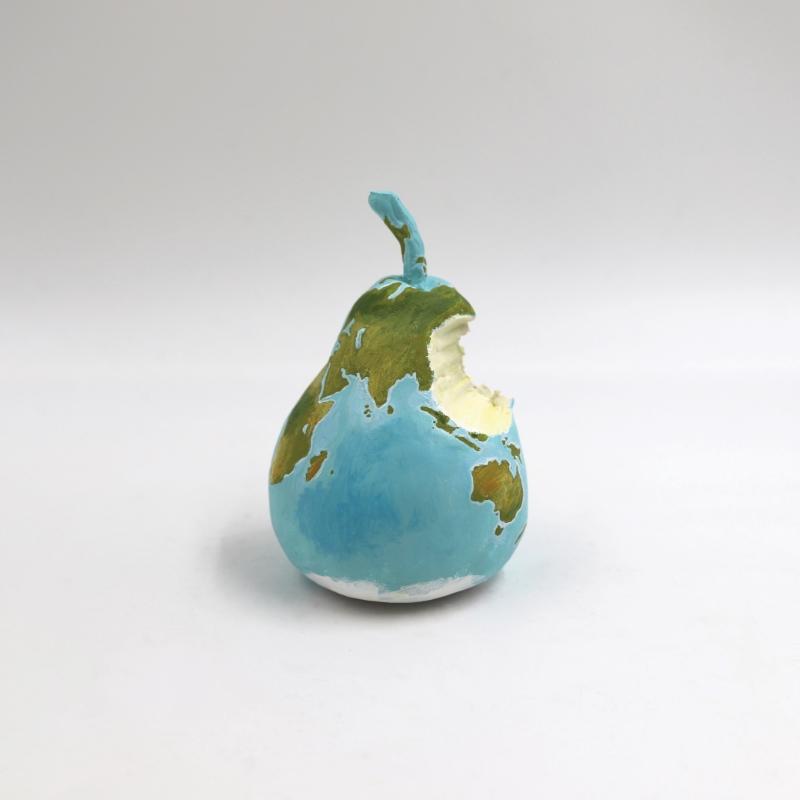
The World’s Gone Pear Shaped, 2022, is so much more than the sum of its parts (plastic, lights and fans, to be precise), it’s also a vessel and a portal for us to address our inner-worlds while engaging with our outer, shared worlds. This larger than life inflated pear-shaped-world first exhibited on the outside of Shepparton Art Museum, as part of White Night, then at Sydney Contemporary, as a part of AMPLIFY, 2022. It is more than a site-specific installation, it’s world-specific. Capturing our collective ambivalence and anxieties around the state of our shared planet, Pittock is reminding us that our daily minor inconveniences – that can easily acquiesce our moods, temperament and thus, projective perceptions – really aren’t that bad. That no matter how or why things go pear shaped, things can still be fruitful. Having actualised, conceptually, through an earthenware depiction of the pear-shaped-world in 2020 and a painting in 2022, all with the same title, the opportunity to bloat, magnify and maximise Pittocks signature pun-like message was a natural progression, “responding to how big issues – personal anxiety, anxieties about the planet – will always feel relevant”. The shift to inflatable from ceramic, large from small, The World’s Gone Pear Shaped was Pittock’s first endeavour in making sculpture at such a large scale, a scale he intends to continue working in. “I love the process of working with inflatables,” he says.
The process of materialising this work was no easy feat. Pittock photographed its smaller predecessor, scanned it three dimensionally, so that every mark made by his hand in clay remained present in plastic patina, offering not only insight into the artists adeptness with clay, but his dexterity in relating to any material he wields. When asked “what’s next?” in true Pittock fashion, he replied, “so many things, I may blow up!”
Featured image above: Installation view of Kenny Pittock’s The World’s Gone Pear Shaped at Sydney Contemporary, 2022. Photo: James Horan. Courtesy: the artist and MARS Gallery, Melbourne.
Featured image below: Kenny Pittock, The World’s Gone Pear Shaped (once bitten), 2022. Acrylic on ceramic, 10.5 x 7.5 x 7.5cm. Courtesy: the artist and MARS Gallery, Melbourne.
This article was originally published in Art Collector issue 103, January-March 2023.
FOLLOW THIS ARTIST
READ MORE
 https://artcollector.net.au/wp-content/uploads/2024/04/2.-AK22826-Install.jpg
1200
1200
Erin Irwin
https://artcollector.net.au/wp-content/uploads/2021/11/Art-Collector-logos-transparency-WHITE-1080x1080px-2.png
Erin Irwin2024-04-25 06:41:542024-04-25 06:41:54Collectors Love: Djakaŋu Yunupiŋu
https://artcollector.net.au/wp-content/uploads/2024/04/2.-AK22826-Install.jpg
1200
1200
Erin Irwin
https://artcollector.net.au/wp-content/uploads/2021/11/Art-Collector-logos-transparency-WHITE-1080x1080px-2.png
Erin Irwin2024-04-25 06:41:542024-04-25 06:41:54Collectors Love: Djakaŋu Yunupiŋu https://artcollector.net.au/wp-content/uploads/2024/04/21A5554.jpg
1200
1200
Erin Irwin
https://artcollector.net.au/wp-content/uploads/2021/11/Art-Collector-logos-transparency-WHITE-1080x1080px-2.png
Erin Irwin2024-04-15 01:59:432024-04-15 02:04:47Artist Profile: Abdullah M. I. Syed
https://artcollector.net.au/wp-content/uploads/2024/04/21A5554.jpg
1200
1200
Erin Irwin
https://artcollector.net.au/wp-content/uploads/2021/11/Art-Collector-logos-transparency-WHITE-1080x1080px-2.png
Erin Irwin2024-04-15 01:59:432024-04-15 02:04:47Artist Profile: Abdullah M. I. Syed https://artcollector.net.au/wp-content/uploads/2024/04/AikoRobinson_AC_AaronClaringbold.jpg
1200
1200
Erin Irwin
https://artcollector.net.au/wp-content/uploads/2021/11/Art-Collector-logos-transparency-WHITE-1080x1080px-2.png
Erin Irwin2024-04-15 01:17:462024-04-15 01:58:32Artist Profile: Aiko Robinson
https://artcollector.net.au/wp-content/uploads/2024/04/AikoRobinson_AC_AaronClaringbold.jpg
1200
1200
Erin Irwin
https://artcollector.net.au/wp-content/uploads/2021/11/Art-Collector-logos-transparency-WHITE-1080x1080px-2.png
Erin Irwin2024-04-15 01:17:462024-04-15 01:58:32Artist Profile: Aiko Robinson https://artcollector.net.au/wp-content/uploads/2024/04/BrieTRENERRY003.jpg
1200
1200
Erin Irwin
https://artcollector.net.au/wp-content/uploads/2021/11/Art-Collector-logos-transparency-WHITE-1080x1080px-2.png
Erin Irwin2024-04-03 08:26:292024-04-03 08:28:54Artist Profile: Brie Trenerry
https://artcollector.net.au/wp-content/uploads/2024/04/BrieTRENERRY003.jpg
1200
1200
Erin Irwin
https://artcollector.net.au/wp-content/uploads/2021/11/Art-Collector-logos-transparency-WHITE-1080x1080px-2.png
Erin Irwin2024-04-03 08:26:292024-04-03 08:28:54Artist Profile: Brie Trenerry https://artcollector.net.au/wp-content/uploads/2024/04/ex.230820_ARTCOLLECTOR__049.jpg
1200
1200
Erin Irwin
https://artcollector.net.au/wp-content/uploads/2021/11/Art-Collector-logos-transparency-WHITE-1080x1080px-2.png
Erin Irwin2024-04-03 07:58:392024-04-03 07:58:39Artist Profile: Monica Rani Rudhar
https://artcollector.net.au/wp-content/uploads/2024/04/ex.230820_ARTCOLLECTOR__049.jpg
1200
1200
Erin Irwin
https://artcollector.net.au/wp-content/uploads/2021/11/Art-Collector-logos-transparency-WHITE-1080x1080px-2.png
Erin Irwin2024-04-03 07:58:392024-04-03 07:58:39Artist Profile: Monica Rani Rudhar https://artcollector.net.au/wp-content/uploads/2024/04/Jan-Murray-Figurine-blue-2023-oil-on-linen-Copy.jpg
2346
2346
Erin Irwin
https://artcollector.net.au/wp-content/uploads/2021/11/Art-Collector-logos-transparency-WHITE-1080x1080px-2.png
Erin Irwin2024-04-03 07:34:162024-04-03 07:34:16Artist Profile: Jan Murray
https://artcollector.net.au/wp-content/uploads/2024/04/Jan-Murray-Figurine-blue-2023-oil-on-linen-Copy.jpg
2346
2346
Erin Irwin
https://artcollector.net.au/wp-content/uploads/2021/11/Art-Collector-logos-transparency-WHITE-1080x1080px-2.png
Erin Irwin2024-04-03 07:34:162024-04-03 07:34:16Artist Profile: Jan Murray