Debutantes: Aaron Christopher Rees
Artists who leading gallerists have thrown their weight behind with a recent debut exhibition.
Words: Diego Ramírez
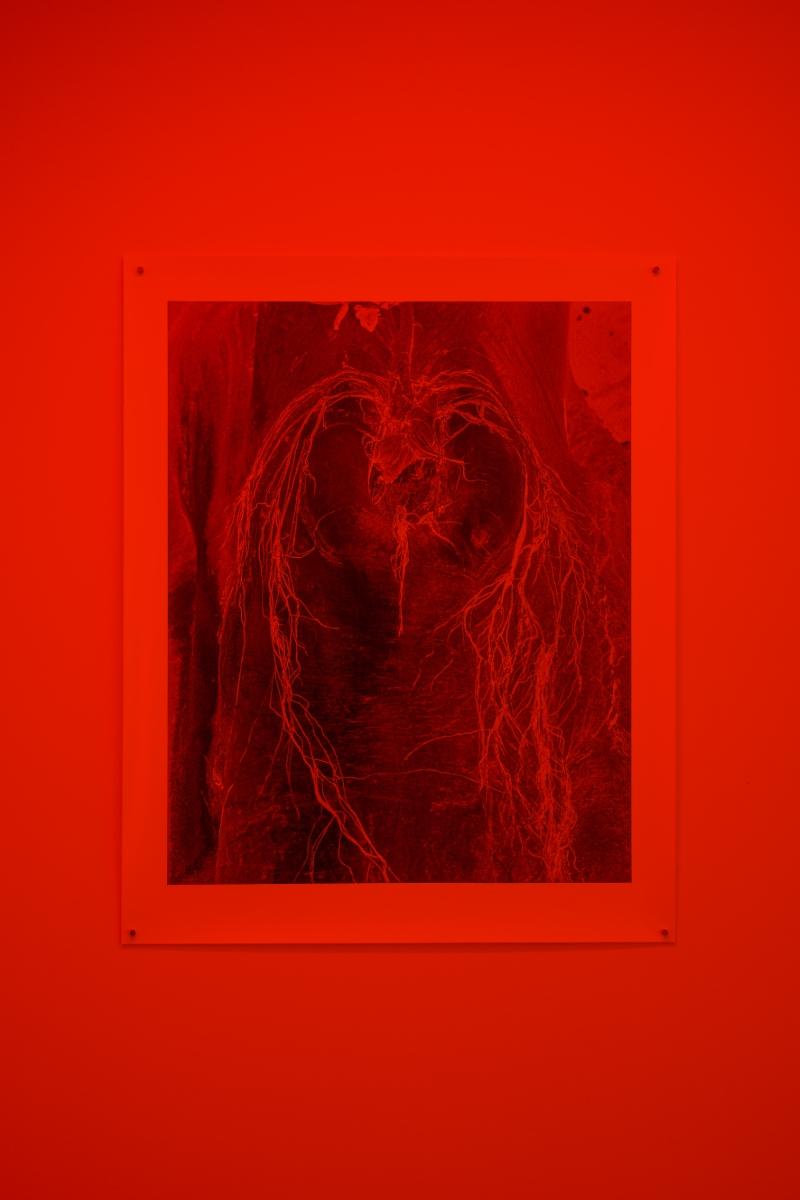
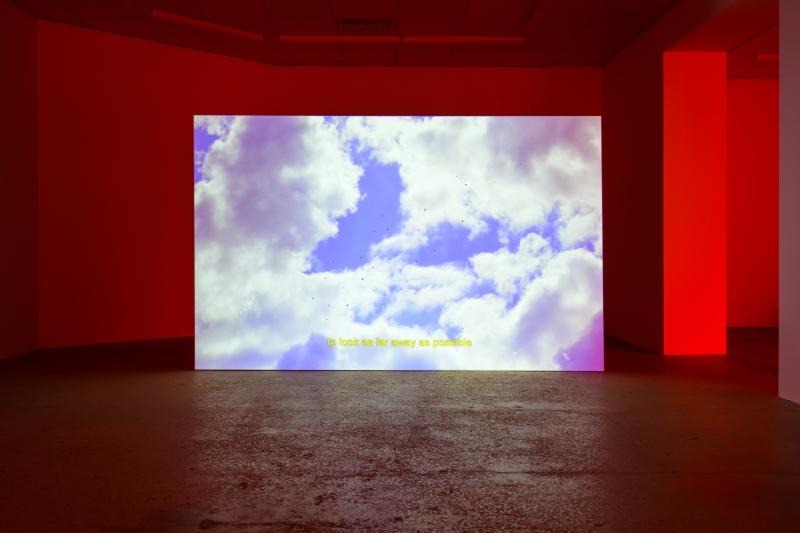
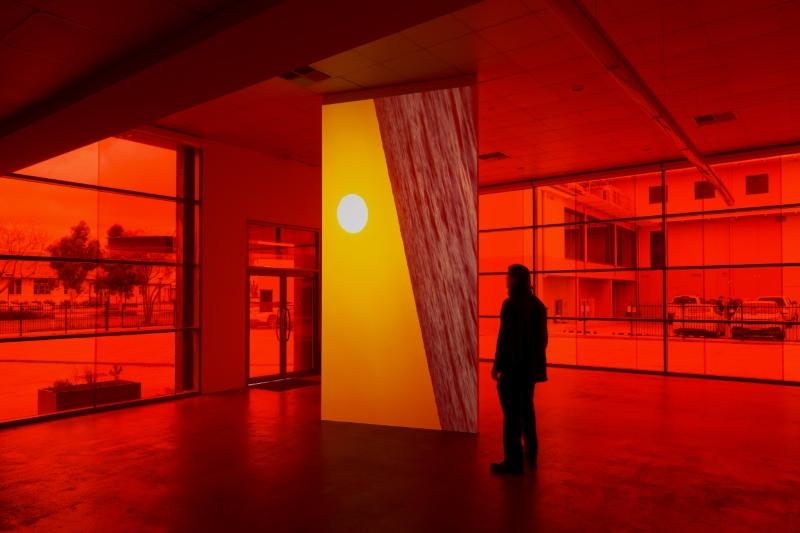
Aaron Christopher Rees employs the photographic lens to document moments of altered perception. This includes shifts in the horizon line, distortions of form and alterations in the hue of light that infiltrates gallery spaces. He is known for creating speculative environments that reference the photographic darkroom, where he places monochromatic prints of desire alongside large scale videos of the sublime, engulfed by an intense red glow. The artist explains, “I have always liked this notion of the photographic apparatus as enabling a vision that speaks to altered states of seeing,” finding his interest in “how photographic technologies enable a playful manipulation of reality, since they are machines through which we see the world.” Indeed, his practice is suspended somewhere in between a chemical high and cinematic marvel.
This interest has served him well, having exhibited in group shows at Melbourne galleries Sarah Scout Presents and LON Gallery, and scheduled to show new work in Melbourne Now, at the National Gallery of Victoria, Melbourne in 2023. His recent solo show at NAP Contemporary, Mildura Firmament, 2022, is emblematic of Rees’ unique approach to the photographic medium. Enveloped in haptic red lighting, the show featured videos of ocular pleasures and a series of prints. The latter also inhabited the realm of desire, by depicting libidinal symbols, such as flowers and bed sheets. However, Rees positions this appeal as an optic stimulation rather than eroticism, by contextualising these scenes with urban and natural landscapes.
One of his signature works is the video Horizon, 2021, a sunset displayed across three screens, rotated to appear as a vertical landscape. “The sunset is the ultimate photographic event,” says the artist, “it contains all the fundamentals of life, such as earth, fire and water.” Rees uses this set up to fracture the viewing experience of this wondrous sight, by forcing the spectator to rotate their heads. This is a strategy that compellingly dates to his childhood, as the artist shares that “when I was a young child, I often watched television upside down. My mum would ask my why and I would reply that it makes the images more interesting.” Rees carefully identifies in this anecdote how the simple act of a viewing a picture upside down is a form of agency for a child in an adult world of mass media. And this is something he has been doing ever since.
Featured image: Installation view of Aaron Christopher Rees’ Fermament at NAP Contemporary, Mildura 2022. Courtesy: the artist and NAP Contemporary, Mildura.
This article was originally published in Art Collector issue 103, January-March 2023.
FOLLOW THIS ARTIST
READ MORE
 https://artcollector.net.au/wp-content/uploads/2024/07/05-Road-to-the-mountains-DSCF8901-Online-crop-1.jpg
1000
1000
Erin Irwin
https://artcollector.net.au/wp-content/uploads/2021/11/Art-Collector-logos-transparency-WHITE-1080x1080px-2.png
Erin Irwin2024-07-18 07:37:442024-07-18 07:38:03Artist Profile: Arryn Snowball
https://artcollector.net.au/wp-content/uploads/2024/07/05-Road-to-the-mountains-DSCF8901-Online-crop-1.jpg
1000
1000
Erin Irwin
https://artcollector.net.au/wp-content/uploads/2021/11/Art-Collector-logos-transparency-WHITE-1080x1080px-2.png
Erin Irwin2024-07-18 07:37:442024-07-18 07:38:03Artist Profile: Arryn Snowball https://artcollector.net.au/wp-content/uploads/2024/07/CHAPMAN-Doreen-scaled.jpg
2560
2560
Erin Irwin
https://artcollector.net.au/wp-content/uploads/2021/11/Art-Collector-logos-transparency-WHITE-1080x1080px-2.png
Erin Irwin2024-07-18 07:17:452024-07-18 07:17:45Artist Profile: Doreen Chapman
https://artcollector.net.au/wp-content/uploads/2024/07/CHAPMAN-Doreen-scaled.jpg
2560
2560
Erin Irwin
https://artcollector.net.au/wp-content/uploads/2021/11/Art-Collector-logos-transparency-WHITE-1080x1080px-2.png
Erin Irwin2024-07-18 07:17:452024-07-18 07:17:45Artist Profile: Doreen Chapman https://artcollector.net.au/wp-content/uploads/2024/07/JP1223_01-1.jpg
1000
1000
Erin Irwin
https://artcollector.net.au/wp-content/uploads/2021/11/Art-Collector-logos-transparency-WHITE-1080x1080px-2.png
Erin Irwin2024-07-17 08:28:552024-07-17 08:28:55Artist Profile: Jason Phu
https://artcollector.net.au/wp-content/uploads/2024/07/JP1223_01-1.jpg
1000
1000
Erin Irwin
https://artcollector.net.au/wp-content/uploads/2021/11/Art-Collector-logos-transparency-WHITE-1080x1080px-2.png
Erin Irwin2024-07-17 08:28:552024-07-17 08:28:55Artist Profile: Jason Phu https://artcollector.net.au/wp-content/uploads/2024/05/zo-658350e7-4f04-4cab-812e-a78f12de8efc-hires-image.jpg
1200
1200
Erin Irwin
https://artcollector.net.au/wp-content/uploads/2021/11/Art-Collector-logos-transparency-WHITE-1080x1080px-2.png
Erin Irwin2024-05-31 03:14:252024-05-31 03:14:25New Directions: David Noonan
https://artcollector.net.au/wp-content/uploads/2024/05/zo-658350e7-4f04-4cab-812e-a78f12de8efc-hires-image.jpg
1200
1200
Erin Irwin
https://artcollector.net.au/wp-content/uploads/2021/11/Art-Collector-logos-transparency-WHITE-1080x1080px-2.png
Erin Irwin2024-05-31 03:14:252024-05-31 03:14:25New Directions: David Noonan https://artcollector.net.au/wp-content/uploads/2024/05/ex.Shadow-Spirit_04.06.2023-Photo_James-Henry.jpg
1200
1200
Erin Irwin
https://artcollector.net.au/wp-content/uploads/2021/11/Art-Collector-logos-transparency-WHITE-1080x1080px-2.png
Erin Irwin2024-05-31 02:39:542024-05-31 03:16:47Curator’s Radar: Brian Robinson
https://artcollector.net.au/wp-content/uploads/2024/05/ex.Shadow-Spirit_04.06.2023-Photo_James-Henry.jpg
1200
1200
Erin Irwin
https://artcollector.net.au/wp-content/uploads/2021/11/Art-Collector-logos-transparency-WHITE-1080x1080px-2.png
Erin Irwin2024-05-31 02:39:542024-05-31 03:16:47Curator’s Radar: Brian Robinson https://artcollector.net.au/wp-content/uploads/2024/05/DSF5978lrg.jpg
830
830
Erin Irwin
https://artcollector.net.au/wp-content/uploads/2021/11/Art-Collector-logos-transparency-WHITE-1080x1080px-2.png
Erin Irwin2024-05-03 09:09:352024-05-03 09:09:35Debutantes: Robbie Fraser
https://artcollector.net.au/wp-content/uploads/2024/05/DSF5978lrg.jpg
830
830
Erin Irwin
https://artcollector.net.au/wp-content/uploads/2021/11/Art-Collector-logos-transparency-WHITE-1080x1080px-2.png
Erin Irwin2024-05-03 09:09:352024-05-03 09:09:35Debutantes: Robbie Fraser