Debutantes: Robbie Fraser
Artists leading gallerists have thrown their weight behind with a recent debut exhibition.
Words: Emil McAvoy
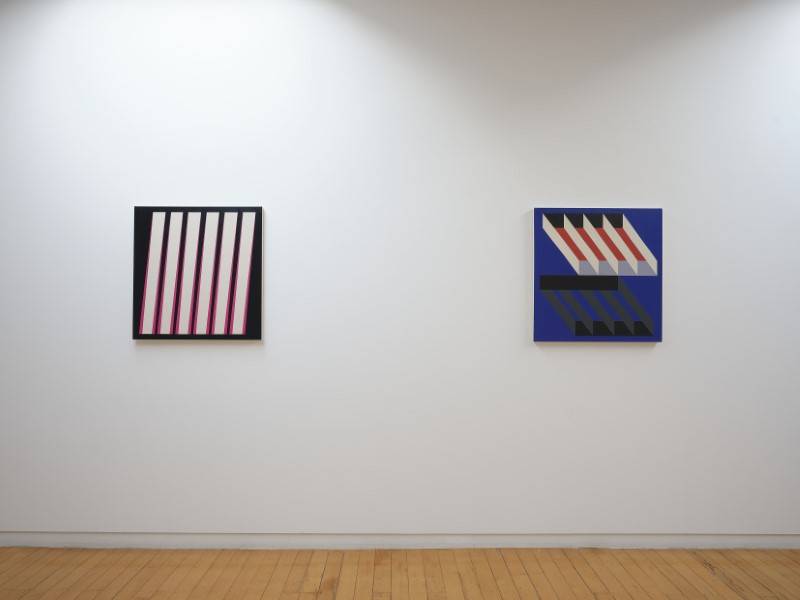
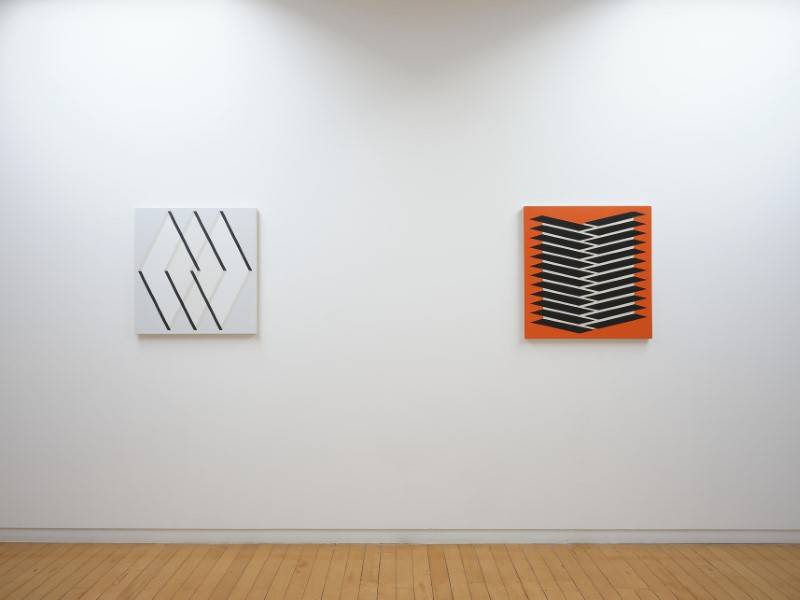
Aotearoa New Zealand artist Robbie Fraser (Ngati Porou ki Hauraki) is immersed in a focused and at times feverish exploration of the poetic and conceptual potential of hard-edged geometric abstraction. He energises this artistic legacy with contemporary flair, unusual use of colour, meticulous attention to craft, and offbeat, playful titles. According to the artist, recurrent themes in his practice include: things that look and sound like other things, painting as object, colour and its extracurricular activities, and the accidentally-on-purpose.
Fraser’s recent exhibition Focus Fever at Two Rooms in Auckland, was his first solo show with a commercial gallery. Two Rooms director Mary-Louise Browne notes: “I have had an eye on Robbie Fraser for some time. I first came across his work more than 20 years ago when he was studying painting, and I was teaching in the same university art school…Robbie’s oil paintings are handmade from carefully worked combinations of colour and shape that optically vibrate. I relish the way he has constantly questioned the capabilities of oil paint and painting, always challenging himself.”
Fraser graduated with a Master of Visual Arts degree (First Class Honours) from Auckland University of Technology in 2013, and was a founding member of FERARI, a popular artist run space in Auckland (2012-14). His paintings optically shapeshift, hovering between two and three dimensions in an interplay which evokes associations as diverse as 1960s Op Art, Futurist aesthetics and Te Ao Māori, but Fraser chooses not to foreground any singular influence, preferring a more even-handed approach. After all, as the artist asserts, things have the habit of looking like other things.
While his work retains a visual similarity to certain previous modes of abstract art, Fraser operates in a parallel space perhaps best described by what it is not. Fraser’s titles often suggest relationships with the visual language of each painting, yet complicate and open up their potential interpretations, and problematise any claim to pure abstraction. Visually accessible yet conceptually oblique, his paintings revel in their associative potential.
Fraser’s exhibition highlights include Selected Works at Northart, Auckland, 2023; SNO 146 at Sydney Non Objective, 2018; Rematerialised (curated by Noel Ivanoff) at DEMO, Auckland, 2017; Painting: A Transitive Space (curated by Simon McIntyre) at St Paul Street Gallery, Auckland, 2016; and A Standard of Measurement (with Hugo Koha Lindsay) at Papakura Art Gallery, Auckland, 2016. Fraser also appeared in Two Rooms’ recent group exhibition Core Sample, 2023. He is currently making new larger scale work which Two Rooms will present at the Aotearoa Art Fair in April 2024.
Featured image above: Installation view of Robbie Fraser’s Focus Fever at Two Rooms, Auckland featuring (left) Premonition (Heaven’s Blades), 2023, oil on canvas, 71.1 x 68.6cm, and (right) Masculine Steampunk (Mulgrew’s Maggot), 2023, oil on canvas, 71.1 x 68.6cm. Photo: Samuel Hartnett. Courtesy: the artist and Two Rooms, Auckland.
Featured image below: Installation view of Robbie Fraser’s Focus Fever at Two Rooms, Auckland featuring (left) Shadow On Reflection, 2023, oil on canvas, 68.6 x 66cm, and (right) Focus Fever, 2023, oil on canvas, 71.1 x 68.6cm. Photo: Samuel Hartnett. Courtesy: the artist and Two Rooms, Auckland.
This article was originally published in Art Collector issue 107, January-March 2024.
FOLLOW THIS ARTIST
READ MORE
 https://artcollector.net.au/wp-content/uploads/2024/07/05-Road-to-the-mountains-DSCF8901-Online-crop-1.jpg
1000
1000
Erin Irwin
https://artcollector.net.au/wp-content/uploads/2021/11/Art-Collector-logos-transparency-WHITE-1080x1080px-2.png
Erin Irwin2024-07-18 07:37:442024-07-18 07:38:03Artist Profile: Arryn Snowball
https://artcollector.net.au/wp-content/uploads/2024/07/05-Road-to-the-mountains-DSCF8901-Online-crop-1.jpg
1000
1000
Erin Irwin
https://artcollector.net.au/wp-content/uploads/2021/11/Art-Collector-logos-transparency-WHITE-1080x1080px-2.png
Erin Irwin2024-07-18 07:37:442024-07-18 07:38:03Artist Profile: Arryn Snowball https://artcollector.net.au/wp-content/uploads/2024/07/CHAPMAN-Doreen-scaled.jpg
2560
2560
Erin Irwin
https://artcollector.net.au/wp-content/uploads/2021/11/Art-Collector-logos-transparency-WHITE-1080x1080px-2.png
Erin Irwin2024-07-18 07:17:452024-07-18 07:17:45Artist Profile: Doreen Chapman
https://artcollector.net.au/wp-content/uploads/2024/07/CHAPMAN-Doreen-scaled.jpg
2560
2560
Erin Irwin
https://artcollector.net.au/wp-content/uploads/2021/11/Art-Collector-logos-transparency-WHITE-1080x1080px-2.png
Erin Irwin2024-07-18 07:17:452024-07-18 07:17:45Artist Profile: Doreen Chapman https://artcollector.net.au/wp-content/uploads/2024/07/JP1223_01-1.jpg
1000
1000
Erin Irwin
https://artcollector.net.au/wp-content/uploads/2021/11/Art-Collector-logos-transparency-WHITE-1080x1080px-2.png
Erin Irwin2024-07-17 08:28:552024-07-17 08:28:55Artist Profile: Jason Phu
https://artcollector.net.au/wp-content/uploads/2024/07/JP1223_01-1.jpg
1000
1000
Erin Irwin
https://artcollector.net.au/wp-content/uploads/2021/11/Art-Collector-logos-transparency-WHITE-1080x1080px-2.png
Erin Irwin2024-07-17 08:28:552024-07-17 08:28:55Artist Profile: Jason Phu https://artcollector.net.au/wp-content/uploads/2024/05/zo-658350e7-4f04-4cab-812e-a78f12de8efc-hires-image.jpg
1200
1200
Erin Irwin
https://artcollector.net.au/wp-content/uploads/2021/11/Art-Collector-logos-transparency-WHITE-1080x1080px-2.png
Erin Irwin2024-05-31 03:14:252024-05-31 03:14:25New Directions: David Noonan
https://artcollector.net.au/wp-content/uploads/2024/05/zo-658350e7-4f04-4cab-812e-a78f12de8efc-hires-image.jpg
1200
1200
Erin Irwin
https://artcollector.net.au/wp-content/uploads/2021/11/Art-Collector-logos-transparency-WHITE-1080x1080px-2.png
Erin Irwin2024-05-31 03:14:252024-05-31 03:14:25New Directions: David Noonan https://artcollector.net.au/wp-content/uploads/2024/05/ex.Shadow-Spirit_04.06.2023-Photo_James-Henry.jpg
1200
1200
Erin Irwin
https://artcollector.net.au/wp-content/uploads/2021/11/Art-Collector-logos-transparency-WHITE-1080x1080px-2.png
Erin Irwin2024-05-31 02:39:542024-05-31 03:16:47Curator’s Radar: Brian Robinson
https://artcollector.net.au/wp-content/uploads/2024/05/ex.Shadow-Spirit_04.06.2023-Photo_James-Henry.jpg
1200
1200
Erin Irwin
https://artcollector.net.au/wp-content/uploads/2021/11/Art-Collector-logos-transparency-WHITE-1080x1080px-2.png
Erin Irwin2024-05-31 02:39:542024-05-31 03:16:47Curator’s Radar: Brian Robinson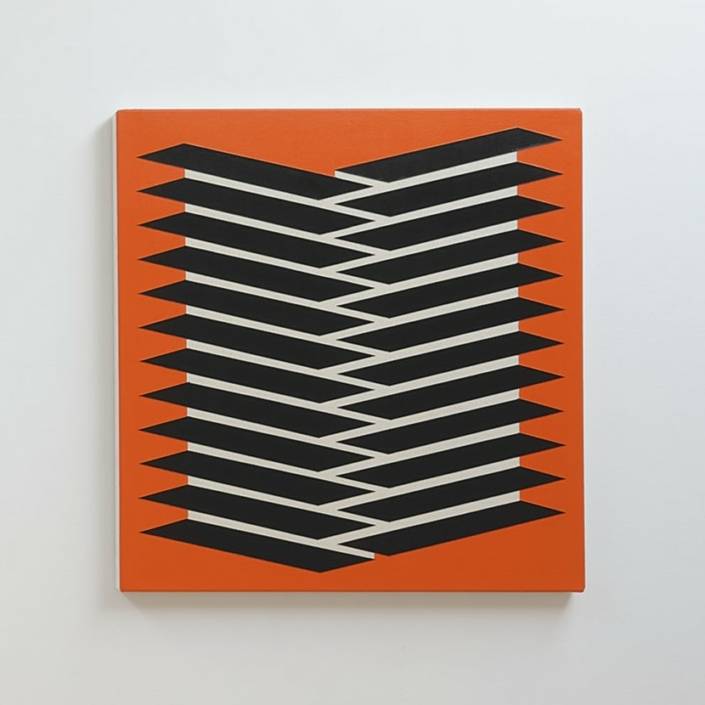 https://artcollector.net.au/wp-content/uploads/2024/05/DSF5978lrg.jpg
830
830
Erin Irwin
https://artcollector.net.au/wp-content/uploads/2021/11/Art-Collector-logos-transparency-WHITE-1080x1080px-2.png
Erin Irwin2024-05-03 09:09:352024-05-03 09:09:35Debutantes: Robbie Fraser
https://artcollector.net.au/wp-content/uploads/2024/05/DSF5978lrg.jpg
830
830
Erin Irwin
https://artcollector.net.au/wp-content/uploads/2021/11/Art-Collector-logos-transparency-WHITE-1080x1080px-2.png
Erin Irwin2024-05-03 09:09:352024-05-03 09:09:35Debutantes: Robbie Fraser