PULL FOCUS WITH EMILY PARSONS-LORD
Emily Parsons-Lord is announced as the winner of ‘the churchie’ national emerging arts prize 2020 by The Institute of Modern Art (IMA) and ‘the churchie’. Selected by curator of Asian Art QAGOMA, Tarun Nagesh, Parsons-Lord is the recipient of the non-acquisitive $15,000 cash prize donated by long-standing sponsor, BSPN Architecture.
Parsons-Lord took out the top prize for her large-scale video work Standing Still (with practice, one may learn to accept the feelings of groundlessness), 2020, which explores climate change-induced cleaving and crumbling, and its residue as a site of extreme physical and emotional destruction.
“Emily Parsons-Lord’s gripping performances and interventions,” tells Nagesh, “revel in the ability to invoke a feeling of wondrous possibility while gesturing toward an impending sense of loss. Through ethereal encounters, underpinned by rigorous intellectual and environmental enquiry, she appeals to our most instinctive bodily reactions and fundamental human concerns.”
The New South Wales based artist was announced the winner at the finalists’ exhibition launch live streamed via the IMA’s social media on Friday 18 September.
Our Pull Focus video series takes its lead from our print magazine feature of the same name. Here, we focus in on what makes a particular artwork WORK as a work of art. Watch Micheal Do in conversation with artist Emily Parsons-Lord about her 2020 Churchie Prize winning work Standing Still (with practice, one may learn to accept the feelings of groundlessness) (2020).
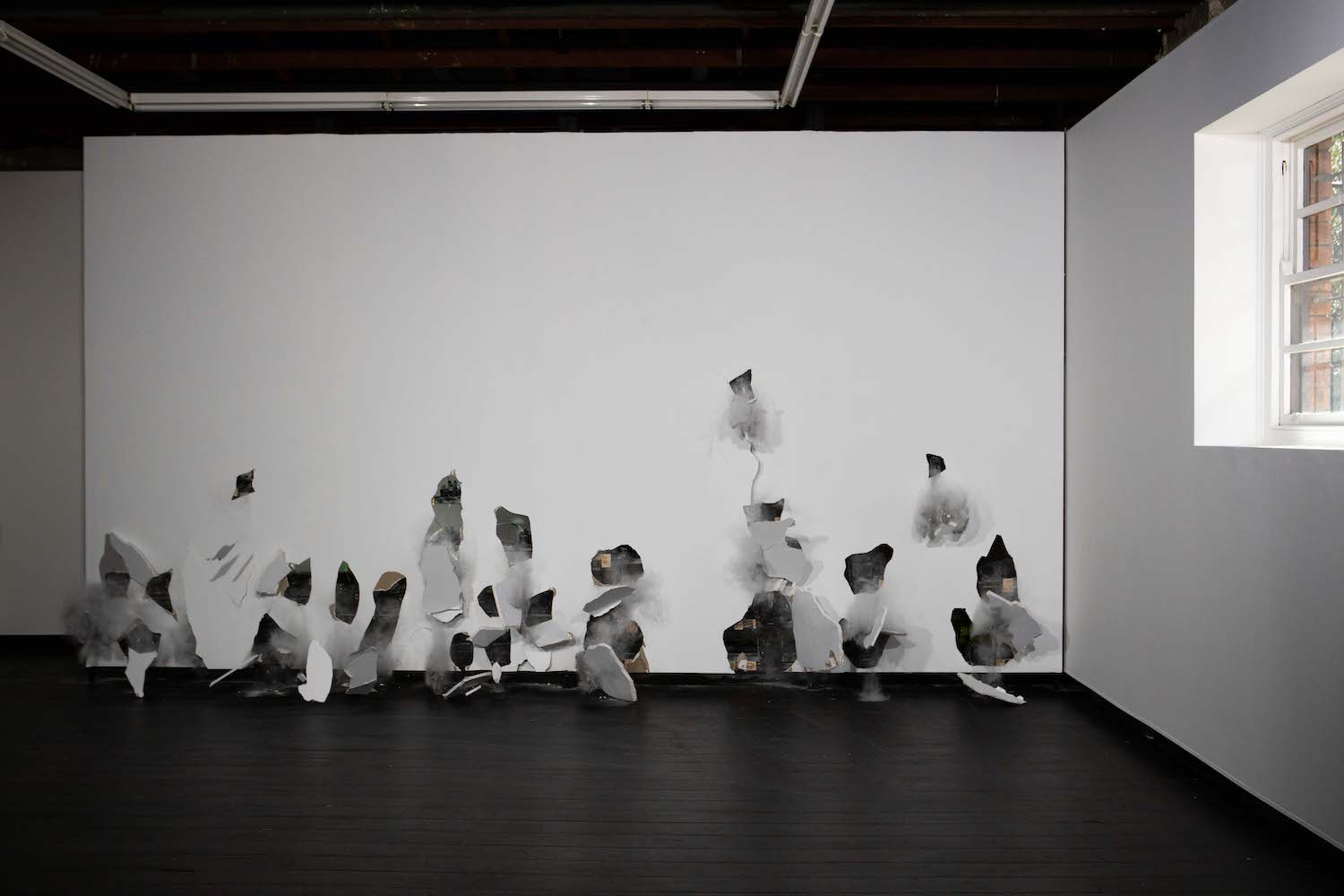
Emily Parsons-Lord, Standing Still (with practice, one may learn to accept the feelings of groundlessness), 2020. HD video. Photo: Maiara Skarheim.
Louis Grant joins Sabbia Gallery
Featured in Art Collector’s 2026 Undiscovered feature, the Ngunnawal Country/Canberra artist joins Sabbia Gallery.
MARS to Miami
The Naarm/Melbourne gallery has signed an agreement to launch MARS Miami — a pop-up model bringing Australian artists to audiences across North America.
Breaking News: Richard Lewer
Responding to his daily newsfeed with paint, Richard Lewer brings fifty-one new works to the Aotearoa Art Fair — a compendium of political flashpoints, personal memory and social observation distilled into an “over-stylised simplicity”.
Words | Emil McAvoy
Richard Lewer in the studio. Photo: Christian Capurro. Courtesy: {Suite}.
Much of Richard Lewer’s latest body of work was catalysed by the artist’s response to his “morning newsfeed”. In conversation, he describes waking to check the latest news update, a common routine for many of us navigating a rapidly changing world increasingly perceived and conceived through a mediating lens. Yet for Lewer, media events frequently stimulate a new painting within a wider process of “making art to understand”.
These new paintings were rapidly executed within a few days, afforded by a turn towards working at a smaller “more intense” scale. The immediacy and intensity reflect Lewer’s responsiveness to developments impacting the public imagination, a personal cultural commentary embedded and materialised in the visual language of painting. Of course, for the artist, news media is only one aspect of collecting information. Lewer’s creative responses also “react to conversations that day, radio interviews, films, telephone conversations…”, likening the act of painting to a conduit for processing these diverse experiences.
The constraints of working at this intimate scale prompt Lewer to further distil complex, layered events and concepts into a highly concentrated form. We discuss the challenges inherent in attempts to reduce complicated and often politically loaded imagery to the leanest of visual means. This imagery is rendered in what Lewer calls an “over-stylised simplicity”, while reflecting on “the vulnerability of the painting”. Indeed, the perceived vulnerability of a painting can at times be its greatest strength.
Working at this scale also facilitates the generation of a more extensive body of work, where larger groupings of paintings hung together can form expanded networks and possibilities of meaning. He describes the fifty-one new works presented at the Aotearoa Art Fair as “a compendium” and “a scattering of incidents and events that are relevant now”.
Richard Lewer, I Used to be a Barrel of Laughs, 2026. Oil on linen, 31 x 31cm. photo: Christian Capurro. courtesy: suite gallery.
Lewer also frequently reviews old photographs, his reflections and painterly translations entering a visual dialogue with the morning news and other sources. Here the micro and macro, personal and political form complex relationships “interwoven with memory”. Word paintings and eclectic imagery — landscapes, portraits, interpretations of media events, memories and other representations — collectively present a fragmentary picture of “the here and now” grounded in the recent past.
The artist describes these paintings as “anecdotes”, a compelling term given its multiple meanings: a short interesting story about a real incident or person, an account regarded as unreliable or hearsay, and the depiction of a minor narrative incident in a painting. In Lewer’s work, it appears possible for all these dimensions to co-exist.
Richard Lewer, Neo-Nazis Occupy Steps of Victoria’s Parliament, 2026. Oil on linen, 31 x 36cm. photo: Christian Capurro. courtesy: {Suite}.
In one painting, Neo-Nazis Occupy Steps of Victoria’s Parliament (2026), based on a televised image, faceless members of an Australian far-right political party dressed in black perform a public Nazi salute, an event which caused a public outcry and led to legislative changes.
The artist also responded to a story of a Jewish man who recounted to news media that he was having trouble sleeping in the aftermath of the recent antisemitic attack at Bondi Beach killing fifteen people during a Hanukkah celebration. Lewer’s painting portrays a man in a nightcap apparently sleeping soundly underneath a single glowing lightbulb, a visible ringlet of hair alluding to his religious background.
Another painting presents a Muslim woman in a niqab riding a modern bicycle, foregrounding the personal as political, and alluding to the often complicated social and cultural layers present in the navigation of everyday life. I can’t get this painting out of my head. These examples are positioned alongside text-based works with phrases such as Keep Your Feelings To Yourself, Cancelled, What Do Art Dealers Really Do, and other figurative paintings including depictions of Air Force One, a doomsday clock, a mushroom cloud entitled If You’re Reading This it’s Too Late (2026), a number of natural environments, and even paintings of fish which appear as if sourced from scientific, educational or fishing material.
Confronting difficult or risky subjects is common in Lewer’s practice. From high-profile disasters to religious themes, from the Waikato Wars in Aotearoa to those impacted by dementia, and paintings visualising anonymous confessions made in a gallery-based confession booth (to name a few), Lewer doesn’t shy away from the increasingly precarious politics of representation.
Yet this is no rage bait in oil paint. Lewer describes his work as a form of “contemporary social realism”. Further, his open, friendly personality, trust in his own genuine intentions, engagement with diverse stakeholders and communities, and the support of others, go a long way in protecting the passage of exhibitions through public spaces in Australia and Aotearoa. At times he has to ignore risk-averse supporters wary of the next exhibition concept, noting “if I’m scared to make something, I know I’m moving in the right direction. As an artist it’s your job”.
Lewer was born in Kirikiriroa/Hamilton, New Zealand, an inspiration for many works. He has been living in Naarm/Melbourne for thirty years, and maintains regular exhibitions in both countries. His return to New Zealand to attend the Aotearoa Art Fair follows a period of significant recognition in Australia, with two major institutional exhibitions at the Geelong Gallery and National Gallery of Australia. The artist is looking forward to the conversations his new work generates, and to reconnecting with people and places.
Richard Lewer, Air Force One, 2026.
Oil on linen, 31 x 36cm.
Richard Lewer, Get Well Soon, 2026. Oil on linen,
41 x 31cm. photo: Christian Capurro. courtesy: {Suite}.
David Alsop
Owner and Director, {Suite}
I’ve been a fan of Richard’s work since the early 2000s, and have worked with him since 2016, so ten years this year! I appreciate his courage in making work about tough subjects, sometimes in the face of criticism. There’s a discipline, an intent and a drive that is special. His work ethic is incredible, and he can even make me laugh while taking on sometimes painful moments of weakness and failure that he’s looking at.
Lewer’s return to the Aotearoa Fair follows a period of extraordinary recognition in Australia, with two major institutional exhibitions at the Geelong Gallery and National Gallery of Australia exploring, respectively, faith and guilt, and a family coming to terms with a dementia diagnosis. He’s been a perennial finalist in the Archibald Portrait Award and Sulman Prize and has won the Paul Guest Prize and the Basil Sellers Art Prize, amongst others. Richard’s works for the Fair are all smaller paintings, in part to have works available at an accessible price point ($4,000-$6,000). In Australia, institutions have been acquiring entire bodies of work, so it will be nice to have a number of works for sale that collectors have an opportunity to engage with.
Richard is among the few trans-Tasman artists with a significant practice in both Australia and New Zealand so there’s always plenty of interest in his work. It’s been a while since a body of smaller — accessibly priced — work has been shown, so we anticipate strong interest from collectors in the works we’ll be showing. One of the exciting things about art Fairs is that we always meet new people. And of course with the internet, people can be looking at work we have, without us even being aware that they’re interested. Richard’s work strikes a chord with seasoned collectors, but also with new collectors. There’s a familiarity about his visual language that resonates with so many.
Richard Lewer, What Do Art Dealers Really Do, 2026. Oil on linen, 31 x 31cm. courtesy: {Suite}.
Richard Lewer, Sunderland Bay, 2026. Oil on linen, 36 x 36cm. courtesy: {Suite}.
Linda Tyler
Director, The University of Auckland,
Centre for Art Studies
The suburb of Glenview in the river city of Kirikiriroa/Hamilton is where Richard grew up. I landed my first curatorial job at the Waikato Museum, about the time he was leaving for art school in the big smoke of Tāmāki Makaurau/Auckland so missed meeting him when he was a Hamilton Boys’ High school student in grey shorts. In 2010 his survey exhibition I Must Learn To Like Myself opened at the museum, memorably featuring large paintings of relentlessly ordinary houses which I recognised as quintessentially Hamilton.
Richard’s practice is often funny, deeply personal, self-deprecating and revealing of devastating truths at the same time. The work deals with big stuff such as love, death, sport and Christianity in a small and persistent way. More than cultural relevance, it has universal significance. Everyone can empathise with the pathos and the pain, unless they are a psychopath, in which case they are a prime subject for a Richard Lewer painting.
Richard Lewer, Snapper, 2026. Oil on linen, 31 x 36cm. courtesy: {Suite}.
First published in Art Collector issue #116 (April–June 2026). In May, Richard Lewer won the 2026 Archibald Prize for his portrait of Iluwanti Ken.
Ai Weiwei to Create Major New Public Artwork for MCA
Ai Weiwei will unveil a major new public artwork on the Warrane/Sydney Harbour foreshore in September 2026.
Lucas Grogan’s Major Commission Unveiled at MONA’s Phrontisterion
Artist Lucas Grogan has unveiled a monumental commissioned work at Phrontisterion.
Monuments for Fishes: Mikala Dwyer unveils major floating artwork in Sydney Harbour
One of the largest floating and kinetic artworks in the world has been unveiled in Watermans Cove at Barangaroo South.
Canberra Artist Annette Blair Wins 2026 FUSE Glass Prize
Canberra Glassworks and JamFactory, South Australia, have announced the winner of the 2026 FUSE Glass Prize.
Telstra NATSIAA Opens as 2026 Judges are revealed
Telstra NATSIAA exhibition opens this week, giving collectors and visitors the chance to spend time with the finalist works in well ahead of the winners’ announcement in August.
Sydney Contemporary reveals the line-up for its 10th edition
More than 100 exhibitors will present work by over 500 contemporary artists, joined by an expanded program marking ten years of the Fair.
George Gittoes donates work to Sydney Peace Foundation
Artist and filmmaker George Gittoes has gifted his new painting Angel of Peace to the Sydney Peace Foundation, marking the announcement of human rights lawyer Jennifer Robinson as the 2026 Sydney Peace Prize Laureate.
AGNSW receives major gift from John and Caroline Laws collection
The collection includes four paintings by John Russell, two by Rupert Bunny and a Brett Whiteley drawing made at the couple’s Oberon property.
Newcastle Art Gallery Opens Mordant Family Gift Exhibition Alongside New Shows by Brian Robinson and Tiyan Baker
The first public presentation of 25 works from the Mordant Family Gift anchors a new group of exhibitions at the expanded Newcastle Art Gallery.
Gemma Smith, Boulder, 2009. Newcastle Art Gallery, Australia, donated through the Australian Government’s Cultural Gifts Program from the Mordant Family Collection 2025. © the artist/Copyright Agency. Photo: Silversalt photography.
Three new exhibitions have opened at Newcastle Art Gallery, led by The Mordant Family Gift, a major presentation of works donated by philanthropists Simon Mordant and Catriona Mordant. The exhibition marks the first time the gift has been shown publicly in full and brings together 25 works across painting, sculpture, photography, installation, textiles and print.
The exhibition represents the largest group of works the Mordant family has gifted to a single institution. Installed across the gallery’s recently expanded spaces, it includes works by Ian Abdulla, María Fernanda Cardoso, Brent Harris, Claire Healy and Sean Cordeiro, Janet Laurence, Hiroyuki Kita, Rafael Lozano-Hemmer, Jamie North, Raquel Ormella, Sangeeta Sandrasegar, Tim Silver, Gemma Smith, Yuken Teruya, Brendan Van Hek, and John Young.
The exhibition arrives as Newcastle Art Gallery continues its first year in its expanded building, which reopened in February after a major redevelopment. More than 80,000 people have already visited the gallery, exceeding its previous annual attendance figures.
Gallery Director Lauretta Morton said the institution is now moving into a broader exhibition program made possible by the new building. “The expansion of the Gallery opens up opportunities to explore exhibitions of a size, scale and number that we were previously unable to present due to the limitations of our original building,” she said.
Alongside The Mordant Family Gift, the gallery has opened Multiverse, the largest survey exhibition to date by Brian Robinson. The exhibition spans the past decade of the artist’s practice and includes more than 30 new and rarely seen works, among them the New South Wales premiere of his immersive installation Zugubal: The winds and the tides set the pace. New commissions developed with Newcastle Art Gallery also draw on objects from the University of Newcastle collection and the intersections of science, mythology and storytelling.
Robinson described the exhibition as a reflection on the multiple worlds that shape his practice. “The title Multiverse suggests the existence of many worlds moving simultaneously — ancestral, spiritual, historical, and imagined,” he said.
Also newly opened is Mouth Mnemonica, the first institutional solo exhibition by Tiyan Baker. Centred on a newly commissioned multi-channel video work, the exhibition draws on the endangered Bukar language spoken by Baker’s mother and members of the Bukar Bidayǔh community of Sarawak, Malaysian Borneo. Combining moving image, sound and sculpture, the project reflects on language as a carrier of memory and cultural knowledge.
Baker described the work as an intergenerational collaboration. “This new body of work combines my poetic verse and my mum’s with found records of our oral poetry culture before colonisation,” she said.
The Mordant Family Gift runs until 8 November 2026, Mouth Mnemonica until 6 September and Multiverse until 30 August.
Winners announced for 2026 Ravenswood Art Prize
Sydney-based artist Monica Rani Rudhar has won the 2026 Ravenswood Australian Women’s Art Prize.
Finalists announced for 2026 Telstra NATSIAA
More than 60 artists have been named finalists in the 2026 Telstra National Aboriginal and Torres Strait Islander Art Awards (Telstra NATSIAA), now in its 43rd year.
Cool Hunter: Emma Buswell
Emma Buswell transforms kitsch cultural moments like the Coles roast chicken bachelor’s handbags into labour-intensive textile works that probe power, mythology, and the absurdities of contemporary Australian life.
Words | Christina Chau
Photography | Bianca Woolhouse
Emma Buswell in her studio. Photo: Bianca Woolhouse.
Emma Buswell is a West Australian-based artist, writer, and curator well known for her large-scale tapestries and knitted works that explore power, culture, and mythology through kitsch and art historical visual tropes. Her work is a humorous endeavour in blending the visual hierarchy between grand narratives and everyday visual culture, while experimenting with scale, form and production.
Buswell’s career has steadily gained traction in the last 15 years leading up to her 2025 Ramsay Art Prize People’s Choice award. She was a resident at Fondazione Antonio Ratti (2011), part of the Australia Council for the Arts Venice Biennale professional development program (2015), was a featured artist in the Indian Ocean Craft Triennial at John Curtin Gallery (2024), has had solo exhibitions across Western Australia and Victoria, and is collected in the State Collection of Western Australia, Artbank, the City of Joondalup and a number of private collections.
Emma Buswell, Between draft and final intentions, 2024. Wool, cotton and acrylic yarn, 165 × 260 × 5 cm. Courtesy: Ava Gallery, Boorloo/Perth.
What is most striking about Buswell’s work is her ability to synthesise cultural events amongst the day-to-day, and highlight their absurdity. For instance, her beaded handbag that mimics a roast chook from Coles, affectionately referred to as the bachelor’s handbag, and her limited edition run of jumpers featuring Mark McGowan’s comment that “There’s nothing unlawful about going for a run and eating a kebab” during a press conference at the height of COVID—these humorous works reflect iconic cultural moments while juxtaposing them with their methods of production. The toil and labour of their making, featuring intricate embroidery and handcraft textiles, encourage viewers to take stock of power and culture in Australia.
Emma Buswell, The Pool, 2024. Wool, cotton and yarn. People’s Choice Award in the 2025 Ramsay Art Prize at the Art Gallery of South Australia. Courtesy: Ava Gallery, Boorloo/Perth.
Buswell’s more recent work is informed by matrilineal handcraft and knitting techniques and she has produced large-scaled knitted tapestries made with her Singer Memo-matic 321—a knitting machine popular in the 1960s associated with domestic hobby craft and textiles. With this tool she’s become more focused on representations of women’s labour and art history and exploring contemporary anxieties around class, politics and echo chambers. Her large-scale work The Pool consists of two tapestries that refer to Narcissus and Echo from Ovid’s Metamorphoses, and Buswell draws connections to contemporary dilemmas around narcissism in politics and the echo chambers that emerge in online media platforms. Buswell is one to watch out for as a millennial keen to synthesise contemporary culture while experimenting with form.
First published in Art Collector issue #115 (January–March 2026).
Collegiality and Confidence
Aotearoa Art Fair returned in 2026 self-assured and energised — and put relationships, not transactions, at its centre.